(The first in a series of three; see footnote below)
Dear Charlie and Jack,
Today I want to write to you about courtship. I know, I know- it sounds old-fashioned and obsolete. I was afraid you wouldn’t even know what this word means so I took it upon myself to search online to preview the meanings you’re going to find in your own search. The Oxford dictionary defines it as “the time when two people have a romantic relationship before they get married.” The Merriam-Webster and Cambridge dictionaries more or less agree. So shall I. It is good enough a starting point for my letter.
- Courtship Rituals: Mine/There/Then and Yours/Here/Now
The initial reason for my exploration of courtship is you, Charlie. In January of this year, out of the blue, you talked to me and your papa about your girlfriend N. You wanted to invite her over for dinner. A few weeks after, we received a text from N’s parents asking us to establish with them some rules on how you and N are to spend time when N visits our house.
Recently, at our Big Sur camping this summer, Charlie and his friends talked a lot about who’s going out with whom. Jack also enlightened us about the drama of middle school dating.

(The camping crew, Front to back, right to left: Cooper; Mike, Justine, Nico, Enzo, Charlie, Jack, Colton)
You both got me thinking about how different all of this was from my high school days in the Philippines! Back then, approximately 35 (!) years ago, going out on dates was not a thing we casually did. We only went out on dates after it was established that we were going “steady” with the other person. As far as what passed for dating, it mainly involved getting snacks after school, either at the only cafe in town where one could get the novelty mini-pizzas and spaghetti with sausage, or from the numerous street vendors that sold freshly fried bananas dripping with thick caramelized sugar and oil. For college students, they could spend their parents’ hard-earned money by watching a movie at the only two theaters in town where they could hold hands or kiss in the dark. Any more beyond kissing and holding hands had to be done outdoors, maybe while out on a mountain hike during the day, or on the boulders in the Sawaga River while ostensibly watching the stars at night.
But before we could even get to the glorious stage of “going steady” and dating, we had to go through various stages of the courting ritual. I am not sure if what we had back then still holds true today but allow me, anyway, to share.
Let’s start from the very beginning, that moment beyond our control when our faces grew hot and our hearts pumped so fast we thought we would explode, simply because that one person we liked, or hated, was near us. When we had what’s aptly called a crush, what did we do? We called it ki-at or biga or kundat. Essentially, it’s flirting. We joked, teased, shouted insults, bragged, told tall tales, wore silly clothes, and did whatever we could to get the other person’s attention. This was how we did beginner level ki-at: low-risk and collective. Sometimes no one even knew who was trying to get the attention of whom, the whole group was flirting with each other.
When we were ready for the next level and wanted to let the other person know we’re interested, we would send our “regards” through a friend. If, for example, while walking down the street with my friends, I saw my crush with his friends walking on the other side of the street, I would nudge one of my friends to holler, “Regards daw si Justine kang X!” Then there would be a collective and boisterous back and forth across the street. I would be giddy because I had revealed my secret! This type of interaction, the sending of regards, could go on for days, months, indefinitely until it either fizzled out or moved on to the next stage.
For the ki-at or regards stage, if the other party was not interested, there was always the deadma route, or pretend ignorance, to freeze or discourage any more attempts. (I just found out the word is a Filipino shortcut for “dead malice”). Or, if one was actually interested but wanted to play “hard to get” or did not want to be too obvious, one could also engage in “paduding” (pretend indifference with a hint of interest).
After we determined there was a spark somewhere, we moved on to the “sabay-sabay” stage. Rooted in the Tagalog word “sabay” which means “together”, this choreography was performed after school when a boy walked the girl he liked (sorry, it was very much a gendered choreo), from the school to her house. If he did it correctly, the boy would also carry the girl’s things for her and walk her all the way to her house, not just partially. It was best to find out ahead of time how many kilometers away her house was, especially because noon time heat was merciless and we only got an hour for lunch break. If the boy happened to want to sabay a girl who was liked by many, he had better be ready and waiting as soon as she left her class room! But if she preferred another person, there was not much he could do even if he was first in line.
After putting in the hours with the sabay-sabay stage, we may then move to the next stage of “pamisita” which comes from the Spanish word visitar, to visit, and is when the boy visits the girl’s home at night, to spend some time chatting with the girl, usually with the parent or a chaperone, like a zealous older brother, in close proximity to prevent shenanigans.
(It used to be a thing but by my time, harana, which is when the guy either plays his guitar or sings a song below the window of the girl’s house, usually with the support of his buddies, was no longer practiced. But had it been still a thing, a good response to the singing would have been the girl opening her window and awarding the guy with a smile; a not so good response would have been a bucket of cold water dumped on the haranistas, and maybe some cussing from an annoyed parent or neighbor to chase away the culprits of the unwanted night serenade.)
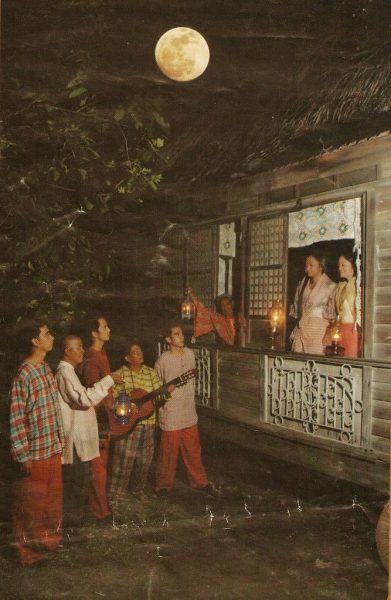
courtesy of Hispano Filipino Heritage Facebook page https://files.world.thaipbs.or.th/2024/04/Harana-1_Photo-courtesy-of-Hispano-Filipino-Heritage-Facebook-page-391×600.jpeg
This, in a nutshell, was how courtship looked like when I was growing up, circa 1980s in Malaybalay, Bukidnon. I won’t walk too far down this memory lane—I have very little dating experience to share, anyway—so suffice it to say that we had such a different way of dating.
Charlie and Jack, may your dating lives be full of laughter and singing and dancing and, above all, may it be consensual for everyone involved!
*I’m writing this in a time of widespread spiritual crisis manifesting in a tyrannical rule that is unleashing its unprocessed fear, grief, and anger on to what it considers the ”other”, e.g., immigrants of color, through hateful acts like mass deportation without due process. It’s easy to despair. As part of my process to sow seeds of a world that is more kind and loving of our kapwa kin, both human and more-than-human, I’m studying, with some members of the Center for Babaylan Studies, humanity’s journey to being “civilized” and “modern”, to understand how and why we are where we are now in our present crises. We recently read essays by Martin Prechtel who wrote a fair bit about courtship. The second and third parts of this essay that I will probably not post here is my inquiry into courtship and its significance to me.

 Ginikanan
